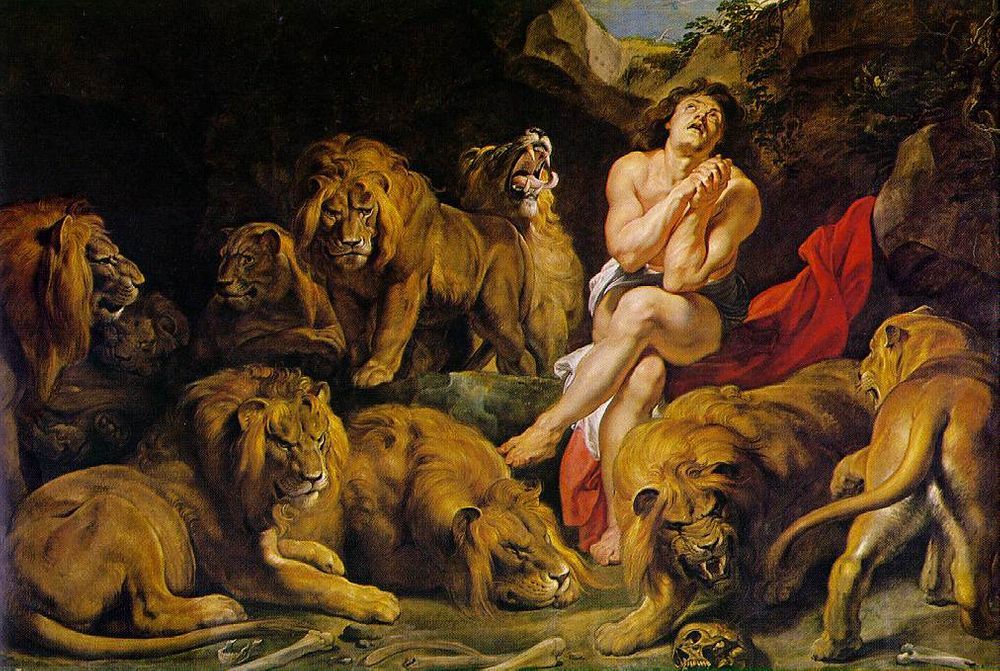
Daniel in the Lions Den
Painted by Sir Peter Paul Rubens (Seigen 1577 - Antwerp 1640)
This is one of the most important paintings connected to the Hamilton family, and its history is well documented in the Hamilton Inventories. It bears testament to the relationship between King Charles I and his courtier the 3rd Marquis, later Ist Duke of Hamilton who as a collector probably hoped to gain even more prestige and influence over the king through picture collecting activities.
This painting was acquired in 1618 with 11 others from the artist Sir Peter Paul Rubens by Sir Dudley Carleton, the English Minister at The Hague. The transaction was completed as an exchange for Sir Dudley's collection of over 100 antique classical busts and statues. From here it passed into the collection of Charles I sometime between 1625 and 1632, where it was hung in the Bear Gallery at Whitehall Palace. As early as 1638 it may have entered the collection of James 3rd Marquis, later Ist Duke of Hamilton (M4/20 314) but was definitely part of his collection by 1643, probably as a gift by the King. Here it is accurately described and is packed in the twenty-sixth case. The picture in his paintings is regularly recorded by contemporary accounts and is in Hamilton inventories until its sale by Christie's in June 1882 (lot no 80)
In the initial exchange of letters in 1616 between Carleton and Rubens, Rubens described the painting as being 'originale tutto de mia mano' This is taken to mean the work was mostly executed by Rubens himself with little help from his workshop. The contemporary painter Jan Breughel documented sketches and copies of the painting in his paintings as early as 1613.
The picture shows the lifelong influence of Tobias Stimmer on Rubens, whose biblical woodcuts Rubens admired and copied in his youth. The acute observation of the lions, their magnificence and size, was due to the use of North African lions as models. These were kept in the Royal menagerie in Brussels. The monumental scale of the picture, the size of the lions portrayed (emphasized by the use of dramatic lighting), the asymmetric structure and the upwards spiral of the figure of Daniel, make this a typically characteristic product of the baroque period and the work of Rubens as a painter.
The painting is probably listed in :
Hamilton Inventory M4/20 entry 314
The painting is listed in :
Hamilton Inventory M4/21/ 'The twenty sixt case'
Hamilton Inventory M4/22/ - 'An Inventory of the Pictures that are Rolled [Up] This is 26 Case'
Hamilton Inventory 7 June 1759 - M4/48 Page 1
1850s Inventory Volume 1228
Hamilton Inventory 1876 Page 82
1882 Illustrated Priced Catalogue Page 21 Cat 80
1882 Illustrated Priced Catalogue illustration on Page 22 and 23
1919 Fine Historical Portraits and Ancient and Modern Pictures Page 18 Cat 57