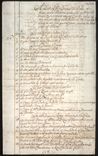
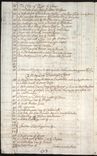
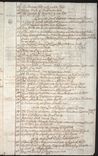
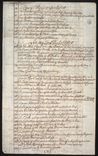
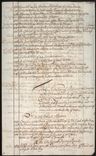
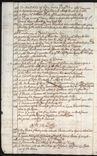
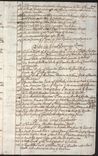
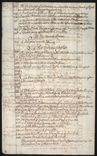
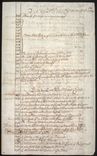
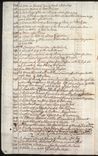
Pathfinder Pack on Hamilton Inventories : 1704 : Manuscript M4/42
VHP 000-000-001-069-L
Inventory of pictures at Holyroodhouse and Kinneil Castle, 8 October 1704
The 1704 inventory gives an overview of the paintings in two Hamilton residences – the ducal apartments in the Palace of Holyroodhouse, in Edinburgh, and the 4th Duke’s Scottish base, Kinneil House, near the town of Bo’ness (about 20 miles west of Edinburgh). It lists over 314 paintings and prints, and records in which rooms they were hung. Information about the furniture and furnishings is recorded in an inventory of 1712.(1)
The 1704 inventory records a wide range of European paintings owned by the heir to the vast Hamilton estates. Many pictures are associated with Italian artists, including Bellini, Mantegna, Perugino, Raphael, Giulio Romano, Correggio, Parmigianino, Giorgione, Titian, Tintoretto, Bassano and Veronese. There are also many English, Flemish and Dutch paintings, including works ascribed or linked to Holbein, Brueghel, Mierevelt, Rubens, Van Dyck and Rembrandt. The most recent creations include 14 portraits by Sir Godfrey Kneller and other portraits by Charles Jervas. One needs to be very cautious about attributions to major ‘Old Masters’ and to note that many works are clearly stated to be copies.
The inventory raises some key questions. First, where are these pictures now, are they what they purport to be, and how good are they? Secondly, who acquired these works and when were they added to the Hamilton collection? It is clear that the early-18th-century Hamilton collection contained a significant number of paintings that had been owned by the 1st Duke of Hamilton. Most of the greatest Italian paintings belonging to the 1st Duke, which had been displayed in his London town house, had been purchased by the Archduke Leopold Wilhelm of Austria, son of the Emperor Ferdinand II, shortly after the Duke’s execution by the Parliamentarians in 1649. But not all of the 1st Duke’s works were included in the sale. Many remained in London and Scotland, and Anne, daughter of the 1st Duke and 3rd Duchess of Hamilton in her own right (1631-1716), was evidently able to reclaim a large proportion of them.
Duchess Anne and her husband, the 3rd Duke of Hamilton (1634-94), obviously added contemporary portraits and other items to the collections. However, the really intriguing issue raised by the 1704 inventory is how many works were added by their son and heir, James, Earl of Arran, and from 1698, 4th Duke of Hamilton (1658-1716)?
James had made a grand tour of France and Italy and had developed sophisticated tastes. Whilst in Rome in 1678, he had commissioned a portrait of himself by Ferdinand Voet (now at Lennoxlove), which cost £55 and is listed in the Great Drawing Room at Kinneil in this inventory (no. 195). James had gone on to live at court in London and to marry Anne Spencer, the eldest daughter of Robert, 2nd Earl of Sunderland, in 1688. The 1704 inventory records that the copy of Titian’s reclining naked female and a man playing the organ in the Duke’s Closet at Holyroodhouse (no. 108) was a gift from the Earl of Sunderland to the Duke from his fine collection of works of art. Unfortunately, it does not record if it was directly connected with the wedding or with the transfer of Sunderland’s Whitehall apartments to the couple at the end of 1688, or a much later present, for Sunderland and the 4th Duke remained friends after Anne’s death in 1690 and were still meeting only a few months before Sunderland’s own demise in September 1702.
As Duchess Anne had retained full ownership of the Hamilton estates, with the exception of that of Kinneil, which she had granted to her eldest son, the 4th Duke had relatively little money to spend. Despite this, he clearly acquired a sizeable number of works, as surviving lists of shipments and the contents of crates drawn up between 1695 and 1699 reveal(2). One of the most interesting was a full-length painting of ‘A King of Spain’, which is listed as the first item ‘packed up in the Great Case’ on 10 July 1699(3). This equates to the full-length portrait of King Philip II of Spain which was hanging in the Duchess’s Drawing Room at Holyroodhouse in 1704 (see no. 18 and the object entry). Here it is worth noting that Duchess Anne had removed almost all her furniture and linen from Holyroodhouse by August 1698, in order that the Duke could use her apartments(4) so it is clear that he was able to install his own property in this room.
Most of the paintings on these lists have still to be tracked down. However, the ‘Madona with A fryer and A Nun By John De’ Belein’ [i.e. Giovanni Bellini], on a list of the Duke’s pictures in London on 12 August 1695, which were apparently subsequently sent up to Scotland(5), is The Virgin and Child with Saints Nicholas of Tolentino and Catherine of Siena by Giovanni di Pietro, known as Lo Spagna, now in the National Gallery of Ireland, Dublin. It was listed in the Duke’s Great Closet at Kinneil in 1704, as number 284, ‘A Madona with our Saviour on her knee with a fryar and a Nun Standing behind, by John de Belein’, and was purchased directly from the 1882 Hamilton Palace sale by the National Gallery of Ireland.
What emerges from a study of the various lists is that the 4th Duke was the recipient of a number of works from the Earls of Sunderland, Macclesfield (a relation of his second wife) and Peterborough, and from other individuals, and that his collection was a combination of purchases and gifts.
It is worth drawing attention to two aspects of the 1704 inventory which might easily escape attention or recognition. The first is the presence of a number of early German and German-related works. These include the portrait of Heinrich Knoblauch by Conrad Faber, dated 1529, now in the National Gallery of Ireland (see no. 266 and the object entry), and twelve small paintings of The Labours of Hercules after engravings by Heinrich Aldegrever (nos. 244-255). Eleven of the latter were placed in a single ebony frame in the 19th century and were among the 18 lots purchased at the 1882 Hamilton Palace sale by the Scottish-American banker Matthias Arnot. Regrettably, they were de-accessioned by the Arnot Art Museum at Elmira, New York State, in the 1970s, and are currently only known from a black and white photograph.
The second point to note are the entries about two square pictures done upon faience (i.e. tin-glazed earthenware) by Raphael of Urbino (nos. 131 and 133). Their ascription to Raphael is, of course, completely erroneous. However, these entries appear to be early references to the collecting of Italian maiolica by Scots, and merit further investigation. It is possible that these pieces were acquired by the 4th Duke during his grand tour in the 1670s.
The 1704 inventory and the early 18th-century inventory of pictures at Hamilton Palace(6) show the Hamilton collection greatly impoverished by the loss of the 1st Duke’s finest paintings (which are now mostly in the Kunsthistorisches Museum in Vienna). Many of the items listed in these two inventories are recorded in the 1759 and 1793 Hamilton Palace inventories, but many of the poorer and lesser works disappear from the collection after the death of the 8th Duke of Hamilton in 1799. They were replaced by the much more important Old Master and contemporary paintings that were added by the 9th, 10th, 11th and 12th Dukes between about 1800 and 1870. Some of these ‘missing works’ were sold or part-exchanged for better or more desirable paintings, while others were sent to minor residences and recede from our sight and knowledge.
1.Edinburgh Register of Testaments, 16 June 1712. See Rosalind K. Marshall, ‘Scarce a Finer Seat in Scotland – Kinneil Castle and the 4th Duke of Hamilton’, in ‘Scottish Country Houses 1600-1914’, edited by Ian Gow and Alistair Rowan, RCAHMS, Edinburgh University Press, 1995, p. 41, note 14.
See especially Hamilton Archive, M4/34, M4/36 and M4/39.
Hamilton Archive, M4/39
Information from Dr Rosalind Marshall 17/09/2015 (Hamilton Correspondence 4239).
Hamilton Archive, M4/33.
Hamilton Archive, M4/41.
Note on transcription with spelling and punctuation modernised
The artists’ names have been checked against the online indexes of the National Gallery London, the National Maritime Museum London, and other digital databases. They are modernised where possible if the name is easily and obviously recognisable. If very different and the transcriber is certain of the transcription, they are put in brackets, if not a suggested name is proceeded with a query. Those names which have not been found are transcribed in their original form.
Words letters and comments added and information supplied by the transcriber are also in square brackets. A query within square brackets indicates that the comment is speculative, inserted words in original manuscript indicated with a backslash .
Minor deletions on the original manuscript have not been included.A dotted line running across the screen indicates the end of a page of the original manuscript
The word ‘piece’ as in ‘sea piece’ means ‘picture
-
-
02 Copy of a portrait of King Charles 11
Literal: 02 A good Coppy of King Charles the 2:
Modernised: 02 A good copy of King Charles II -
13 Copy of a portrait of Queen Anne
Literal: 13 A good Coppy of Queen Ann a halfe length
Modernised: 13 A good copy of Queen Ann[e] a half length -
14 King Henry V11 a quarter length
Literal: 14 A quarter Length of King Henry the 7th.
Modernised: 14 A quarter length of King Henry VII -
19 James, 2nd Marquis of Hamilton
Literal: 19 A small length of James Marquiss of Hamilton L[or]^d Steward to King Jamy. 6th
Modernised: 19 A small length of James, Marquis of Hamilton, L[or]d Steward to King James VI -
18 Philip 11 of Spain
Literal: 18 An Original Picture of Phillip the 2. king of Spaine at full length laying his hand upon Fame by -----
Modernised: 18 An original picture of Phillip II, King of Spain at full length laying his hand on Fame by -----
-
-
-
80 King William
Literal: 80 King William's Picture in an ovall, done by Cross.
Modernised: 80 King William's picture in an oval, done by Cross.
-
-
-
-
136 Countess of Northumberland
Literal: 136 The Countess of Northumberland Grandmother to the present Dutchess of Somersett done by Vandike
Modernised: 136 The Countess of Northumberland grandmother to the present Duchess of Somerset done by van Dyck
-
-
-
153 James V1 by Van Somer
Literal: 153 An ovall head of King James ^t^h6. 3qu^t^r^s. long after Vanzoma
Modernised: 153 An oval head of King James VI three quarters long after Vanzoma [?Van Somer] -
154 Henry V111 after Holbein
Literal: 154 A square picture of King Henry ^t^h 8. a halfe length by Holbin
Modernised: 154 A square picture of King Henry VIII a half length by Holbein -
159 James Duke of Hamilton by Mytens
Literal: 159 A peice of James Duke of Hamilton a full length holding his hat betwixt his fingers leaning upon his stick by Mysen
Modernised: 159 A piece of James Duke of Hamilton a full length holding his hat between his fingers leaning upon his stick by Mysens [Mytens] -
165 James Marquis of Hamilton - right hand with glove
Literal: 165 A full length of James Marquiss of Hamilton leaning upon a - table with his right Hand by his side with a glove in it.
Modernised: 165 A full length of James Marquis of Hamilton leaning upon a - table with his right hand by his side with a glove in it. -
170 King James V11 by Kneller
Literal: 170 An ovall peice of King James the 7th 3quarter long by S.^i ^r GodfreyKneller.
Modernised: 170 An oval piece of King James VII three quarter long by Sir Godfrey Kneller.
-
-
-
193 Oval - William Duke of Hamilton brother to James
Literal: 193 An ovall of William Duke of Hamilton brother to James Duke of Hamilton
Modernised: 193 An oval of William Duke of Hamilton brother to James Duke of Hamilton -
194 Oval - William Duke of Hamilton by Kneller
Literal: 194 William Duke of Hamilton father to the p^r^esent Duke in an ovall by S^r Godfery Kneller
Modernised: 194 William Duke of Hamilton father to the present Duke in an oval by Sir Godfrey Kneller. -
197 John Hamilton Earl of Ruglen by Kneller
Literal: 197 John Hamilton Earle of Ruglen 3^d son in an ovall by Kneller
Modernised: 197 John Hamilton Earl of Ruglen 3rd son in an oval by Kneller -
198 George Hamilton Earl of Orkney by Kneller
Literal: 198 George Hamilton Earle of Orkney 4^th son in an ovall by Kneller
Modernised: 98 George Hamilton Earl of Orkney 4th son in an oval by Kneller -
199 Basil Hamilton by Kneller
Literal: 199 Lord Bassill Hamilton 5 son in an ovall by Kneller
Modernised: 199 Lord Basil Hamilton 5th son in an oval by Kneller -
204 Lady Ann Spencer by Kneller
Literal: 204 Lady Ann Spencer Countess of Aran in an oval by Kneller
Modernised: 204 Lady Ann Spencer Countess of Arran in an oval by Kneller -
209 James Duke of Hamilton in armour by Romey
Literal: 209 A whole length in small of James Duke of Hamilton in armore by Romey
Modernised: 209 A whole length in small of James Duke of Hamilton in armour by Romey -
195 James Duke of Hamilton by Voet
Literal: 195 James Duke of Hamilton eldest son to William Duke of Hamilton by Fardinan
Modernised: 195 James Duke of Hamilton eldest son to William Duke of Hamilton by Fardinan
-
-
-
214 Earl of Newport by Mytens
Literal: 214 A small picture of Blunt Earle of Newport at length don by Mitings
Modernised: 214 A small picture of Blunt [Blount] Earl of Newport at length done by Mitings [Mytens -
218 Lott and his 2 daughters
Literal: 218 a Dutch peice of Lott and his 2 daughters. –
Modernised: 218 A Dutch piece of Lot and his 2 daughters. – -
236 Duchess of Richmond
Literal: 236 The Dutchess Richmond by S^r Peter Lilly after Vandike.
Modernised: 236 The Duchess Richmond by Sir Peter Lely after van Dyck
-
-
-
256 King of Bohemia
Literal: 256 The King of Bohemiah's picture by Merry Velt.
Modernised: 256 The King of Bohemia's picture by Miereveld. -
257 Queen of Bohemia
Literal: 257 The Queen of Bohemiahs picture by Merry Velt.
Modernised: 257 The Queen of Bohemia’s picture by Miereveld. -
259 Mierevelt self portrait
Literal: 259 Merryvelts picture by himselfe........
Modernised: 259 Miereveld’s picture of himself........ -
269 James V11 by Wissing
Literal: 269 King James 7.^t^h in a large ovall frame by Wisser
Modernised: 269 King James VII in a large oval frame by Wisser [Wissing] -
Heinrich Knoblauch
Literal: 266 A man with a Black Bonnet upon wood a small 3quarter size by Holbin
Modernised: 266 A man with a black bonnet upon wood a small three quarter size by Holbein
-
-
-
288 Countess of Manchester
Literal: 288 The Countess of Manchester after vandike
Modernised: 288 The Countess of Manchester after van Dyck -
292 Officer and 2 servants
Literal: 292 A piece done by Rumee of some Great Officer with his horse and two servants in blew standing by a cannon
Modernised: 292 A piece done by Rumee [?Remigius (Remy or Remee ) Van Leemput] of some great officer with his horse and two servants in blue standing by a cannon
-