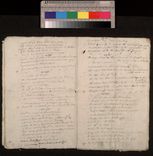
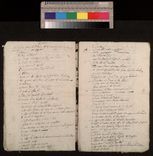
Pathfinder Pack on Hamilton Inventories : ?1643 (before 12th April) : Manuscript M4/22 :
VHP 000-000-000-609-C
Hamilton Inventory M4/22: A Catalogue of My Lord's Pictures: List of paintings of James, 3rd Marquis, later 1st Duke of Hamilton, c. 1643
M4/22 is a list of 600 paintings packed into 44 cases, the third surviving inventory of three from this period, the others being M4/20 and M4/21. It probably dates to a period after the summer of 1638 when the heart of the 3rd Marquis of Hamilton's picture collection was formed after the arrival of a shipment of paintings from Venice. These pictures had been purchased on specific instructions from the 3rd Marquis of Hamilton to Lord Basil Feilding, English ambassador to the Venetian Republic from 1636-1638 and brother-in-law to the Marquis. The list may have been written slightly later, at about the time of the start of the Civil War in 1642. However, the closely related inventory M4/21 is listed as being "A Catalogue of my Lo/: Marquesses Pictures//." and both inventories must probably predate April 1643 when the Marquis was elevated to the Dukedom.
Two of these inventories, M4/21 and M4/22, are very similar, listing the same 600 pictures and refer to specific locations such as closets in an unspecified house. However, this inventory M4/22 gives us even more snippets of information about the location and condition of the paintings. There were pictures or "little pieces that were in the galleries" and some pictures that are rolled up in the 26th case. There is also a tantalising and sole reference in both inventories to "12 cases with 28 of the best statues". It is not known what became of these sculptures or indeed where they came from.
The unspecified intended location of both inventory contents may have been the house Chelsea Place built in 1639 by the 3rd Marquis. The land for this building was bought eleven days after the death of the his wife Lady Mary Feilding, 3rd Marchioness of Hamilton on 10th May 1638. The family's previous home at Wallingford House, Whitehall had been leased to the Marchioness as a personal favour by her aunt by marriage, the widowed Duchess of Buckingham.
The writer of M4/22 appears to be less sophisticated than the writer of M4/21 although his phonetic spelling was characteristic of the period. He is more likely to be a Scot, referring to the 2nd Marquis as "My Lord's faither", and evidently knows the family well. Is this list (M4/22) a first draft and written before M4/21? The writer of M4/21 is more refined, writing in a less hurried style. Perhaps M4/21 is merely checking, tidying up or finalizing this first draft of M4/22. There also remains the possibility that these inventories were drawn up completely separately for different reasons although this seems less likely.
- Ernest Vegelin Van Claerbergen, * David Teniers and the Theatre of Painting*, The Courtauld Institute of Art Gallery, 2006,pp14
- Klara Garas, *Jahrbuch der Kunsthistorischen Sammlungen in Wien * 'Die Entstehung der Galerie des Erzherzogs Leopold Wilhelm' xxvii (1967), pp139-180
- Paul Shakeshaft, Burlington Magazine, "To Much Bewiched with Thoes intysing things": The letters of James, Third Marquis of Hamilton and Basil, Viscount Feilding, concerning Collecting in Venice 1635-1639", February 1986, cxxviii, 995, p78+114-134
Note on transcription
Transcription with spelling and punctuation modernised:
The artists names have been checked against the comprehensive List of Artists on the National Gallery, London website, artprice.com and similar online resources and modernised where possible. Those names which have not been found are transcribed in their original form.
Words added and information supplied by the transcriber are in square brackets. A query within square brackets indicates that the comment is speculative.
Minor deletions on the original manuscript have not been included.
The word 'of' before the name of an artist means 'by' and is usually preceded by a semi colon in this modernised transcript, e.g. '; of Old Palma' means '; by Old Palma'.
The word 'piece' as in 'A piece of the Samaritan' means 'picture'.
'Ye' has been transcribed as 'the'. For contracted words such as 'wt', the missing letters have been supplied in square brackets, thus: w[i]t[h]
A dotted line, .................... indicates the end of a page in the manuscript
-
-
St Margaret and the Dragon by Giulio Romano and Raphael
Literal: 2 St Marguerite of Raffel & a peace of old Palma that was over the chymnely in the closet
Modernised: 2 St Marguerite of [by] Raphael, and a piece; of [by] Old Palma; that was over the chimney in the closet
-
-
-
The Three Philosophers by Giorgione
Literal: The Astronomers of Georgeon.
Modernised: The Astronomers; of Giorgione
-
-
-
Young Woman at Her Toilet by Giovanni Bellini
Literal: A naket women halfe waye w[i]t[h] a Red draperie about her/
Modernised: A naked woman, half way [half-length], with a red drapery about [around] her
-