Pathfinder Pack on Hamilton Inventories : 1638 (after February) : Manuscript M4/20
VHP 000-000-000-085-L
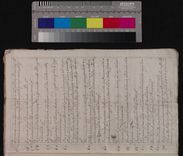
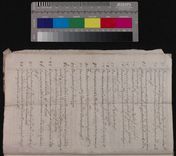
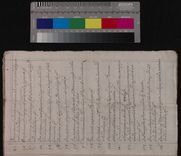
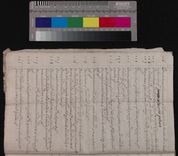
List of 384 paintings belonging to James, 3rd Marquis, later 1st Duke of Hamilton, written after February 1638
This inventory of 384 paintings must date from after 1638. Entry number 27, A Madonna after Raphael now in Warsaw is inscribed with a note implying that it was the gift of Charles 1 to the Marquis of Hamilton in February 1638. Overall the inventory reveals the underlying strength of Hamilton's Flemish and Northern European painting with its sea and landscapes and genre painting.
Some entries are detailed, others cursory, some are without the name of the artist, or the artists name is mis-spelt or distorted. A second authors hand is evident and this is identified as that of Hamilton himself. He adds artists named to the entries, information that may have come from another written document or may have been hearsay. The process of digitisation with the subsequent viewing of the inventories on a backlit screen has allowed two deleted items to be read for the first time. After item 273, the inventory maker has added, 'One coppy of a white horse of my lords doeinge/ One coppy of an ?Italian head of my lords doeing' and someone, possibly the 3rd Marquis himself, has scored out the words. However inaccurate they were, they appear to imply that he had personally copied some drawings, thereby giving us a tiny corroboration that he was not only or merely interested in paintings from motives of prestige or commerce, but had a genuine liking for art which was, incidentally, inherited by his grandson the 4th Duke.
The very heart of Hamilton's remarkable collection of paintings and especially his Venetian collection was formed between 1636-1638, in a very short space of time. The inventory includes pictures from the collection of Niccolo Renieri, one of the most important and expert 17th Century Venetian art dealers. This period of collecting was before the Marquis left London to take up arms against the Scottish Covenanters in 1638. In 1635 his wife's aunt by marriage, the widowed Duchess of Buckingham, lent her and her family Wallingford House.This mansion stood on the site now occupied by Admiralty House and had been purchased by The Duke of Buckingham, who had lived there until he acquired the more splendid York House. Wallingford House had been lent to Lady Mary as a favour, and in the Ratebook for 1638 she and not her husband appeared as the tenant. When she died, the 3rd Marquis had to find another home because the Duchess of Buckingham, now remarried, intended to lease the property to someone else.
Eleven days after his wife's death, the 3rd Marquis therefore had Francis Vernon buy for him the manor house of Chelsea and proceeded to build an entirely new house adjoining the New Manor, with a main gallery and an upper gallery where his pictures would have been displayed. This was an appropriate place to house a picture collection of this magnitude and a property from which to participate in the political, social and administrative life of the court of Charles 1.
- Klara Garas,* Jahrbuch der Kunsthistorischen Sammlungen in Wien* 'Die Entstehung der Galerie des Erzherzogs Leopold Wilhelm' xxvii (1967), pp139-180
Note on transcription:
The words in Italics and bold are in the handwriting of the 3rd Marquis himself
The artists names have been checked against the comprehensive List of Artists on the National Gallery, London website, artprice.com and similar online resources and modernised where possible. Those names which have not been found are transcribed in their original form.
Words added and information supplied by the transcriber are in square brackets. A query within square brackets indicates that the comment is speculative.
Minor deletions on the original manuscript have not been included.
The word 'of' before the name of an artist means 'by' and is usually preceded by a semi colon in this modernised transcript, e.g. '; of Old Palma' means '; by Old Palma'.
The word 'piece' as in 'A piece of the Samaritan' means 'picture'.
'Ye' has been transcribed as 'the'. For contracted words such as 'wt', the missing letters have been supplied in square brackets, thus: w[i]t[h]
A dotted line, .................... indicates the end of a page in the manuscript
-
-
85: James, 3rd Marquis of Hamilton by Daniel Mytens
Literal: 85 One picture of my lords, standinge at length, with his hatt in his hande of mittens
Modernised: 85 One picture of My Lord [James, 3rd Marquis, later 1st Duke of Hamilton], standing at length [a full-length portrait], with his hat in his hand; of Mytens
-
-
-
94: Gustavus Adolpus, King of Sweden
Literal: 94 One picter of the kinge of Sweede at length, of
Modernised: 94 One picture of the King of Sweden [Gustavus Adolphus], at length [full-length]; of -
95: James, 2nd Marquis of Hamilton by Daniel Mytens 1610
Literal: 95 One picture of my Lords father at length of
Modernised: 95 One picture of My Lord's father [James, 2nd Marquis of Hamilton], at length; of -
96: Lady Mary Feilding by Daniel Mytens
Literal: 96 One picture of my Lady, to the middle in a ruffe, with a feather in her heade of mittens
Modernised: 96 One picture of My Lady [Lady Mary Feilding, wife of the 3rd Marquis of Hamilton], to the middle, in a ruff, with a feather in her head; of [Daniel] Mytens
-
-
-
126: Hippopotamus & Crocodile Hunt - by Sir Peter Paul Rubens
Literal: 126 One picture of a Crocodile.
Modernised: 126 One picture of a crocodile.
-